New Hole Theory: Sky Beam Hypothesis!
Friday, July 8th, 2022 11:18 pm![[personal profile]](https://www.dreamwidth.org/img/silk/identity/user.png) snoozefestaudio
snoozefestaudioSo, I've been thinking about Wednesday's forest hypothesis to explain the Percy Jones Hole phenonmenon and... just kept thinking...
Even if there were some extaordinary way for a bunch of trees to open a hole in a storm... why would it only happen in Aurora?
Let's take another look at that radar frame where the hole first tears open...
.png)
You can see the hole opens almost directly over the center of town... though it does expand southward and later drifts to the south.
But is Aurora really the first large stand of trees those storm systems meet after crossing over the great plains? I had to look at Google Earth again.
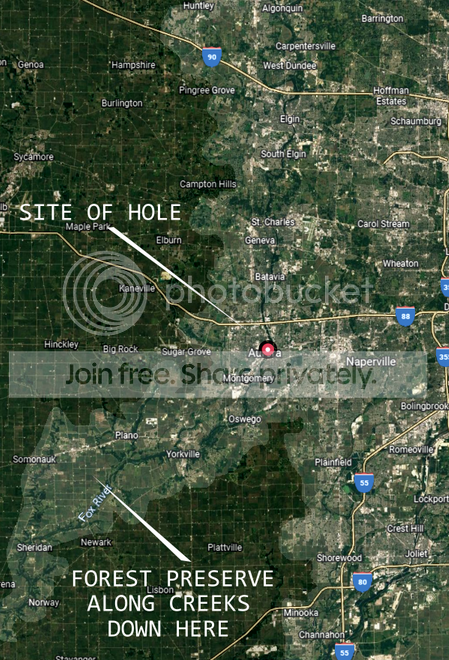
In the above pic, the western boundary of the Chicago metro is highlighted, including areas that are either forested, paved, or both. And What we see in the lower left is that there's a network of large creeks well to the west of Aurora, that are heavily forested along their banks.
All of that land along the banks is protected forest preserve land, so... if the trees of Aurora could conceivably open a hole in a storm system out of self defense, then these stretches of wild forest would be able to do that even better!
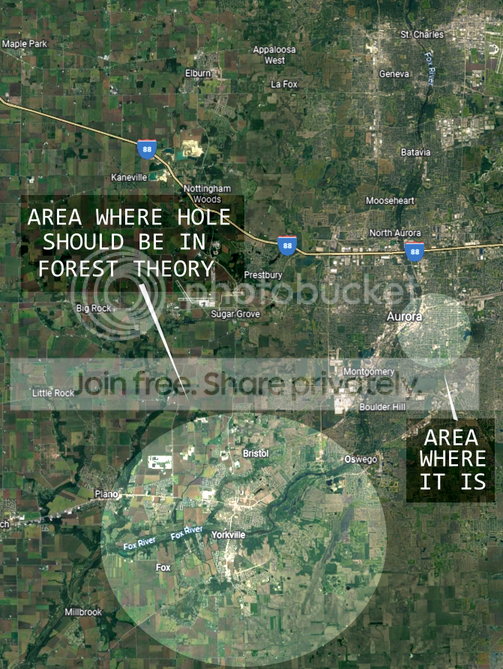
According to the forest hypothesis, the hole should exist around Plano and Yorkville, because this is the first, forest-defended area that any system will meet.
But actually, if you look at the first photo, that whole area was yellow and red bands. Plano and Yorkville got the full brunt of that storm system.
Meanwhile, the area where the hole actually forms, up in Aurora, is not much different from the rest of the metro along that edge of the Fox River. It's all just a bunch of pavement and domsestic trees, with some little corridors of greener space here and there.
But nothing makes Aurora stand out... from a biological perspective.
Yet the hole definitely always forms right over the center of Aurora, so there has to be some other explanation.
What the hell is special about the center of Aurora?
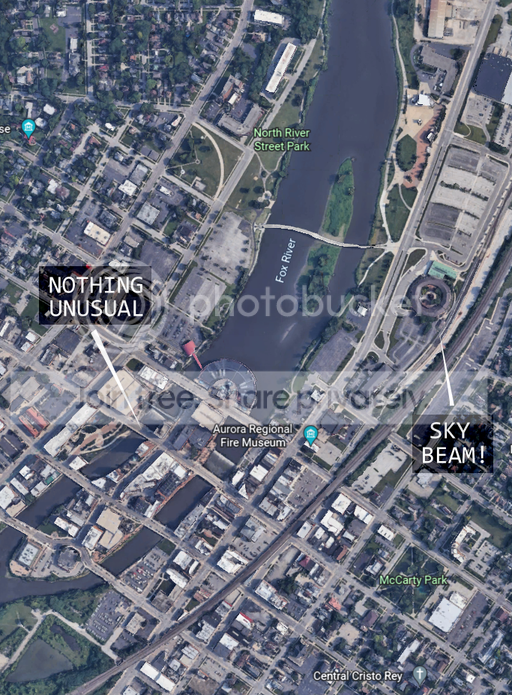
The river island, lower left, connected by four bridges, and fully developed, is Stolp Island, and this is the center of town.
But there's nothing about Stolp Island that's special, from a weather perspective. It's just streets and buildings like any other downtown area up and down the Fox River, or anywhere else in the metro.
But then, my eye went to that Death Star looking feature on the right!
Wait! Really?..
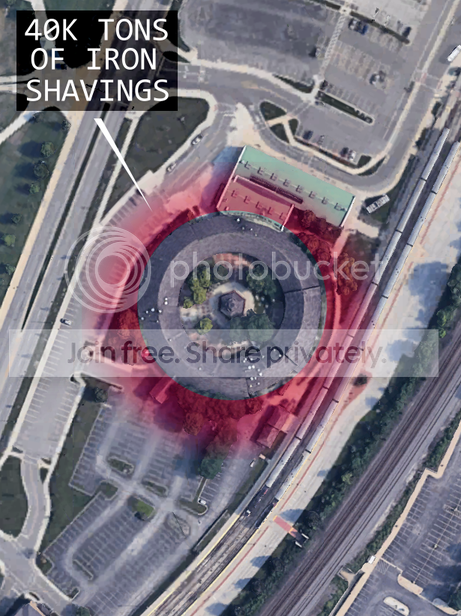
What you're looking at is the Round House.
Back in the mid 1800s, as the transcontinental railroad was in it's infancy, Aurora became the main railroad hub west of Chicago. All rail lines around the metro, and those coming in from, or out to the west, came through this Round House.
Engines would pull in to the center where they were rotated on a huge turn table, and set onto different tracks for different journeys, east, west, north, and south.
But it wasn't just an exchange hub where engines could be moved from one line to another.
The round house was also a factory, where locomotive engines were built. And they weren't just built there... Every single part was MACHINED there, on lathes!
--<>--
The round house machined whole engines, on lathes, for about 100 years, between 1855 to 1955. Which MEANS... they generated a LOT of metal shavings and filings.
This was the industrial revolution, so you KNOW... nobody gave the first shit about recycling waste materials... or about responsible waste management. So my guess is that all of those shavings and filings... just got dumped on the floors, or dumped out the windows, or dumped on the grounds.
But we'll be charitable and assume they did bother to shovel some of it into barrels to be sold back to some foundary as scrap to be melted down, for a little extra cash. Even if that were true, you KNOW they still left a lot of it laying around on site.
Given that one locomotive is about 30 tons of steel, it's reasonable to assume they generated at least one ton per day, of shavings and filings, that just got trampled into the dirt on site.
That would give us 365 tons per year. And over 100 years, that would be, 36,500 tons ferris metal, sunk into the soil, all concentrated in that small circular spot of about two acres. But we'll round it up to forty thousand tons.
Forty... thousand... tons!
------------{=0=}------------
What I like about this hypothesis is... this WAS unique to Aurora!
That round house was the only one of it's kind in the metro, outside of the Chicago Loop. And it was also the only locomotive factory in the midwest! Even Chicago didn't machine and build locomotives.
In other words, there was no other, tiny, two-acre dot on the landscape, packed with forty thousand tons of metal shavings.
I know, I know... you're saying, what about scrap yards? what about junk yards? what about iron ore deposits?
Well, I dunno, Susan!... I would presume most scrap and junk yards are more on the order of forty tons, or maybe four hundred tons. But not FORTY THOUSAND tons! And that's huge hunks of junk out on the surface.
We're talking forty thousand tons of finely particulated iron, steel, and nickel powder, crunched down into the soil in a small area, and that's gotta have a unique electrical signature... which I'll get to below.
As for ore deposits... again, I dunno! Maybe storm holes do open up over ore deposits? Or maybe it doesn't work the same because iron ore is lumpy and not granulated?
Or maybe... there's not forty thousand tons jammed into a two-acre area... surrounded by nothing else like that for hundreds of miles?
------------{=0=}------------
The round house was abandoned in the mid 1950s... just an eyesore on the landscape with all the windows broken out by kids throwing rocks through them.
This would align perfectly with the arrival of Percy Jones to Aurora!
By then, the full forty thousand tons was in the ground at that site... very close to the center of town. And shortly thereafter, Percy began to notice the weird phenomenon of thunderstorms always skirting around the city on their way past.
Which lead him to conclude that, we're living in a hole!
So the Sky Beam Hypothesis meets that criteria too! It's unique to Aurora, and has been unique since at least the 1950s.
------------{=0=}------------
Okay, so, how would it actually work?
In the sky beam hypothesis, the huge concentration of ferris metal at the site of the round house is not causing a magnetic anomaly... but an electrical one.
It not about the Earth's magnetic field... but the Earth's electrical field.
The ionosphere... a layer of charged ions, surrounding the globe, at the top of the atmosphere, has a net positive charge. And meanwhile the surface... or the ground, has a net negative charge.
With the atmosphere as an insulator between these two oppositely charged plates, the Earth is a giant capacitor.
And this leads to all kinds of phenomena we don't notice, such as the fact that at every moment of every day, ions are coming up out of the ground, often through blades of grass, and the tips of tree leaves... and floating away up to the ionosphere.
There is a constant flux in the Earth's electrical field, which varies from place to place, based on geology, geography, and biology. But in fair weather, it goes unnoticed.
The ionosphere is also responsible for bouncing radio transmissions, heading out into space, back down toward the surface, at such angles that make it possible for ham radio operators to communicate half way around the globe with one another.
--<>--
Thunderstorms, meanwhile, are also very electrical. But for them, it's all static electricity, generated by water droplets, whipped into a frenzy by up and down drafts circulating within the storm... rubbing against one another and exchanging electrons.
Storm systems are highly negatively charged with static electricity. They're MORE negative than the ground. And that's saying something, because the ground is... the ground! it's normally the most negative you can get.
But since storms are more negative than the ground, it means that the ground beneath a storm system is... relatively... positively charged!
This is why thunderstorms not only exchange electrical charge (lightning) down to the ground below, but also up to the ionosphere above... and even from cloud to cloud.
They're just crazy electrical bitches zapping in all directions!
--<>--
Okay, so NORMALLY... all those iron filings below the round house aren't doing anything.
But according to the sky beam hypothesis, when a storm system moves over that forty thousand ton bundle of... STEEL WOOL... beneath the ground, it INDUCES a charge in the metal!
But because we know the hole phenomenon is repulsive to storms, and not attractive, that induced charge must be a negative charge... equal to or greater than the negative charge of the storm.
The charge induced at the site of the round house is negative enough, to repel all rain droplets above it.
But once it's created that pinprick through the cloud cover... it opens a channel straight up to the ionosphere!
A sky beam!
A passive sky beam of stable electrical flux thorugh the middle of a chaotic storm of static electricity... but a sky beam none the less!
This sky beam then ionizes the air around it to be repulsive to the storm, in a pocket that expands and drifts like a bubble... with green band rain being weakly charged enough to penetrate the periphery, but yellow and red band rain too highly charged to get through.
The storm system then follows the path of least resistence. It either moves north or south of the sky beam... or if it is forced to push into the sky beam... it dissipates.
And the sky beam doesn't lose power... until the electrical potential of the storm system has gone away.
Once the storm is gone... the iron below the round house de-energizes, and the sky beam dissolves!
--<>--
There's NO WAY I'll have to get any more technical than THAT, about this hypothesis, and have to study atmospheric electrical theory for the rest of my life!
------------{=0=}------------
Honestly, all I really care about here is... why the hell can I never get a good thunder recording from home? Why do these voids always open up around me, when it's raging everywhere else?
I know it's not magic! I know it's not the government, or the Jews! I'm just trying to find the actual, natural explanation... no matter how crazy it might be!
What I like most about the round house, sky beam hypothesis, is that it's just the kind of monsterously permanent, unintended consequence, you'd expect from the industrial age!
The round house site was never properly cleaned up, but the structure also wasn't torn down. Instead, it survived into the 1990s, whereupon the structure was renovated to become a trendy bar and brewery, but the grounds were just paved over with asphalt.
There was no ecological study to test for soil contamination... like they did at other sites of railroad activity that were completely torn down and reformatted for new construction.
The round house just sat there abandoned for forty years and then... somebody spruced it up, threw a new roof on, and threw a parking lot around it.
What harm would four thousand tons of rusting metal do anyway? It's not like it was some kind of chemical poison! it's just rust in the dirt! Who cares?
And even if they did accidentally create a storm repulsing sky beam... so what? Shouldn't that be a good thing?
It is... dammit!
It's a good thing for the trees, and for the safety of the town.
It's only a bad thing, for me. :(
°¦}
https://soundcloud.com/snoozefestaudio
Even if there were some extaordinary way for a bunch of trees to open a hole in a storm... why would it only happen in Aurora?
Let's take another look at that radar frame where the hole first tears open...
You can see the hole opens almost directly over the center of town... though it does expand southward and later drifts to the south.
But is Aurora really the first large stand of trees those storm systems meet after crossing over the great plains? I had to look at Google Earth again.
In the above pic, the western boundary of the Chicago metro is highlighted, including areas that are either forested, paved, or both. And What we see in the lower left is that there's a network of large creeks well to the west of Aurora, that are heavily forested along their banks.
All of that land along the banks is protected forest preserve land, so... if the trees of Aurora could conceivably open a hole in a storm system out of self defense, then these stretches of wild forest would be able to do that even better!
According to the forest hypothesis, the hole should exist around Plano and Yorkville, because this is the first, forest-defended area that any system will meet.
But actually, if you look at the first photo, that whole area was yellow and red bands. Plano and Yorkville got the full brunt of that storm system.
Meanwhile, the area where the hole actually forms, up in Aurora, is not much different from the rest of the metro along that edge of the Fox River. It's all just a bunch of pavement and domsestic trees, with some little corridors of greener space here and there.
But nothing makes Aurora stand out... from a biological perspective.
Yet the hole definitely always forms right over the center of Aurora, so there has to be some other explanation.
What the hell is special about the center of Aurora?
The river island, lower left, connected by four bridges, and fully developed, is Stolp Island, and this is the center of town.
But there's nothing about Stolp Island that's special, from a weather perspective. It's just streets and buildings like any other downtown area up and down the Fox River, or anywhere else in the metro.
But then, my eye went to that Death Star looking feature on the right!
Wait! Really?..
What you're looking at is the Round House.
Back in the mid 1800s, as the transcontinental railroad was in it's infancy, Aurora became the main railroad hub west of Chicago. All rail lines around the metro, and those coming in from, or out to the west, came through this Round House.
Engines would pull in to the center where they were rotated on a huge turn table, and set onto different tracks for different journeys, east, west, north, and south.
But it wasn't just an exchange hub where engines could be moved from one line to another.
The round house was also a factory, where locomotive engines were built. And they weren't just built there... Every single part was MACHINED there, on lathes!
The round house machined whole engines, on lathes, for about 100 years, between 1855 to 1955. Which MEANS... they generated a LOT of metal shavings and filings.
This was the industrial revolution, so you KNOW... nobody gave the first shit about recycling waste materials... or about responsible waste management. So my guess is that all of those shavings and filings... just got dumped on the floors, or dumped out the windows, or dumped on the grounds.
But we'll be charitable and assume they did bother to shovel some of it into barrels to be sold back to some foundary as scrap to be melted down, for a little extra cash. Even if that were true, you KNOW they still left a lot of it laying around on site.
Given that one locomotive is about 30 tons of steel, it's reasonable to assume they generated at least one ton per day, of shavings and filings, that just got trampled into the dirt on site.
That would give us 365 tons per year. And over 100 years, that would be, 36,500 tons ferris metal, sunk into the soil, all concentrated in that small circular spot of about two acres. But we'll round it up to forty thousand tons.
Forty... thousand... tons!
What I like about this hypothesis is... this WAS unique to Aurora!
That round house was the only one of it's kind in the metro, outside of the Chicago Loop. And it was also the only locomotive factory in the midwest! Even Chicago didn't machine and build locomotives.
In other words, there was no other, tiny, two-acre dot on the landscape, packed with forty thousand tons of metal shavings.
I know, I know... you're saying, what about scrap yards? what about junk yards? what about iron ore deposits?
Well, I dunno, Susan!... I would presume most scrap and junk yards are more on the order of forty tons, or maybe four hundred tons. But not FORTY THOUSAND tons! And that's huge hunks of junk out on the surface.
We're talking forty thousand tons of finely particulated iron, steel, and nickel powder, crunched down into the soil in a small area, and that's gotta have a unique electrical signature... which I'll get to below.
As for ore deposits... again, I dunno! Maybe storm holes do open up over ore deposits? Or maybe it doesn't work the same because iron ore is lumpy and not granulated?
Or maybe... there's not forty thousand tons jammed into a two-acre area... surrounded by nothing else like that for hundreds of miles?
The round house was abandoned in the mid 1950s... just an eyesore on the landscape with all the windows broken out by kids throwing rocks through them.
This would align perfectly with the arrival of Percy Jones to Aurora!
By then, the full forty thousand tons was in the ground at that site... very close to the center of town. And shortly thereafter, Percy began to notice the weird phenomenon of thunderstorms always skirting around the city on their way past.
Which lead him to conclude that, we're living in a hole!
So the Sky Beam Hypothesis meets that criteria too! It's unique to Aurora, and has been unique since at least the 1950s.
Okay, so, how would it actually work?
In the sky beam hypothesis, the huge concentration of ferris metal at the site of the round house is not causing a magnetic anomaly... but an electrical one.
It not about the Earth's magnetic field... but the Earth's electrical field.
The ionosphere... a layer of charged ions, surrounding the globe, at the top of the atmosphere, has a net positive charge. And meanwhile the surface... or the ground, has a net negative charge.
With the atmosphere as an insulator between these two oppositely charged plates, the Earth is a giant capacitor.
And this leads to all kinds of phenomena we don't notice, such as the fact that at every moment of every day, ions are coming up out of the ground, often through blades of grass, and the tips of tree leaves... and floating away up to the ionosphere.
There is a constant flux in the Earth's electrical field, which varies from place to place, based on geology, geography, and biology. But in fair weather, it goes unnoticed.
The ionosphere is also responsible for bouncing radio transmissions, heading out into space, back down toward the surface, at such angles that make it possible for ham radio operators to communicate half way around the globe with one another.
Thunderstorms, meanwhile, are also very electrical. But for them, it's all static electricity, generated by water droplets, whipped into a frenzy by up and down drafts circulating within the storm... rubbing against one another and exchanging electrons.
Storm systems are highly negatively charged with static electricity. They're MORE negative than the ground. And that's saying something, because the ground is... the ground! it's normally the most negative you can get.
But since storms are more negative than the ground, it means that the ground beneath a storm system is... relatively... positively charged!
This is why thunderstorms not only exchange electrical charge (lightning) down to the ground below, but also up to the ionosphere above... and even from cloud to cloud.
They're just crazy electrical bitches zapping in all directions!
Okay, so NORMALLY... all those iron filings below the round house aren't doing anything.
But according to the sky beam hypothesis, when a storm system moves over that forty thousand ton bundle of... STEEL WOOL... beneath the ground, it INDUCES a charge in the metal!
But because we know the hole phenomenon is repulsive to storms, and not attractive, that induced charge must be a negative charge... equal to or greater than the negative charge of the storm.
The charge induced at the site of the round house is negative enough, to repel all rain droplets above it.
But once it's created that pinprick through the cloud cover... it opens a channel straight up to the ionosphere!
A sky beam!
A passive sky beam of stable electrical flux thorugh the middle of a chaotic storm of static electricity... but a sky beam none the less!
This sky beam then ionizes the air around it to be repulsive to the storm, in a pocket that expands and drifts like a bubble... with green band rain being weakly charged enough to penetrate the periphery, but yellow and red band rain too highly charged to get through.
The storm system then follows the path of least resistence. It either moves north or south of the sky beam... or if it is forced to push into the sky beam... it dissipates.
And the sky beam doesn't lose power... until the electrical potential of the storm system has gone away.
Once the storm is gone... the iron below the round house de-energizes, and the sky beam dissolves!
There's NO WAY I'll have to get any more technical than THAT, about this hypothesis, and have to study atmospheric electrical theory for the rest of my life!
Honestly, all I really care about here is... why the hell can I never get a good thunder recording from home? Why do these voids always open up around me, when it's raging everywhere else?
I know it's not magic! I know it's not the government, or the Jews! I'm just trying to find the actual, natural explanation... no matter how crazy it might be!
What I like most about the round house, sky beam hypothesis, is that it's just the kind of monsterously permanent, unintended consequence, you'd expect from the industrial age!
The round house site was never properly cleaned up, but the structure also wasn't torn down. Instead, it survived into the 1990s, whereupon the structure was renovated to become a trendy bar and brewery, but the grounds were just paved over with asphalt.
There was no ecological study to test for soil contamination... like they did at other sites of railroad activity that were completely torn down and reformatted for new construction.
The round house just sat there abandoned for forty years and then... somebody spruced it up, threw a new roof on, and threw a parking lot around it.
What harm would four thousand tons of rusting metal do anyway? It's not like it was some kind of chemical poison! it's just rust in the dirt! Who cares?
And even if they did accidentally create a storm repulsing sky beam... so what? Shouldn't that be a good thing?
It is... dammit!
It's a good thing for the trees, and for the safety of the town.
It's only a bad thing, for me. :(
°¦}


